Scene Mask Annotation 3D
Repository: https://github.com/OlafenwaMoses/vizion3D
Category: Annotation
Experimental: No
SceneMaskAnnotation3D runs semantic segmentation on a 2D RGB image, then back-projects the per-pixel class labels onto the matching 3D points in a point cloud. The result groups the cloud by scene class — walls, floor, ceiling, furniture, and so on — and an annotated point cloud where every point is recoloured by its class's fixed palette colour.
A real photo is optional. When no image is provided the task synthesises a front-view RGB image by projecting the point cloud's own XYZ+RGB data into a 2D canvas; the segmentation then runs on that synthetic view.
Point-cloud inputs and outputs use OpenGL/viewer camera space: X+ right, Y+ up, and Z- forward into the scene.
!!! note "This task is semantic, not instance"
Semantic segmentation assigns every pixel exactly one of 150 ADE20K classes, so each 3D point belongs to exactly one class. The output therefore has one annotation per class present in the scene — all wall points are grouped into a single entry, all floor points into another — rather than one entry per discrete object.

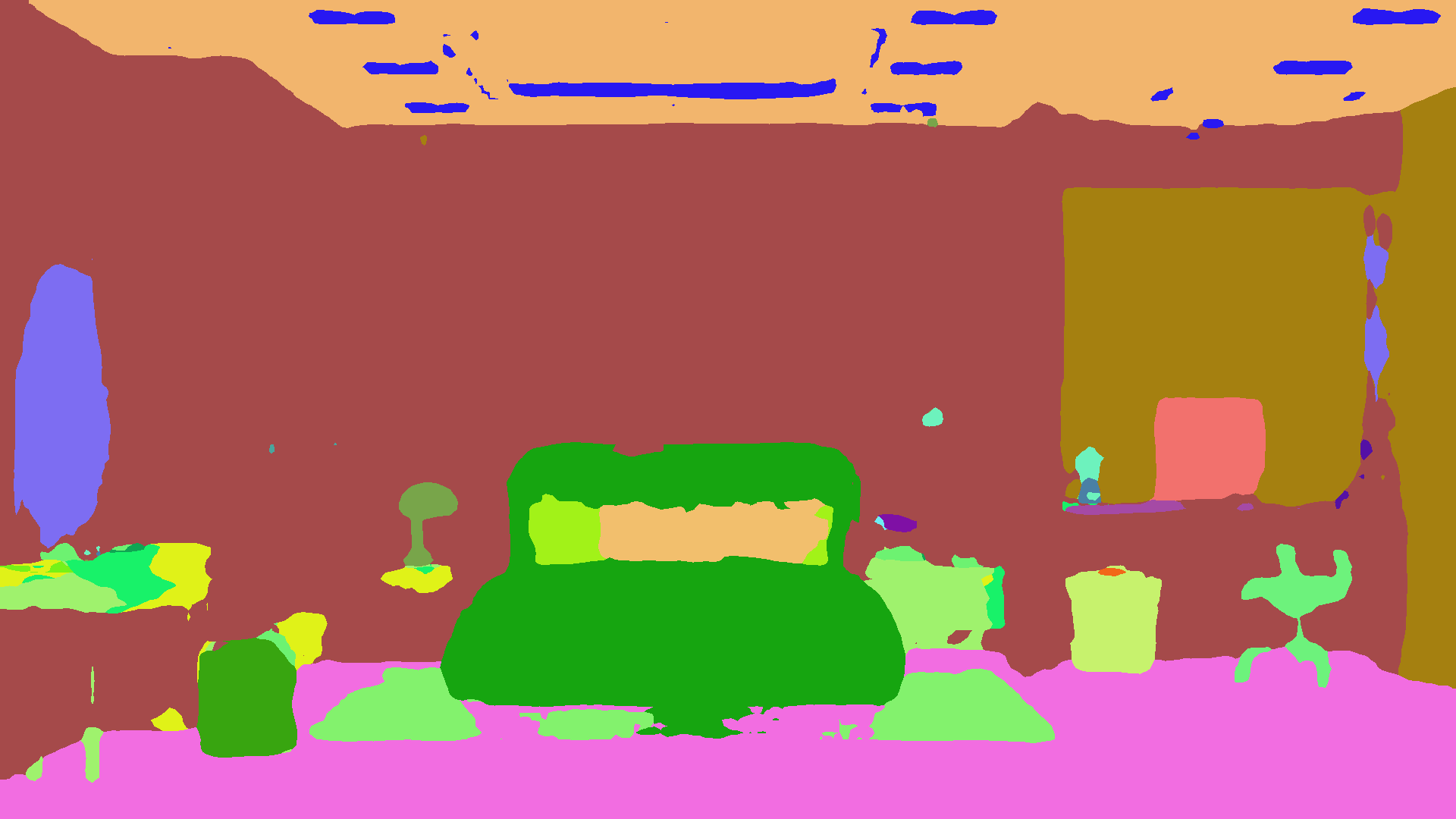
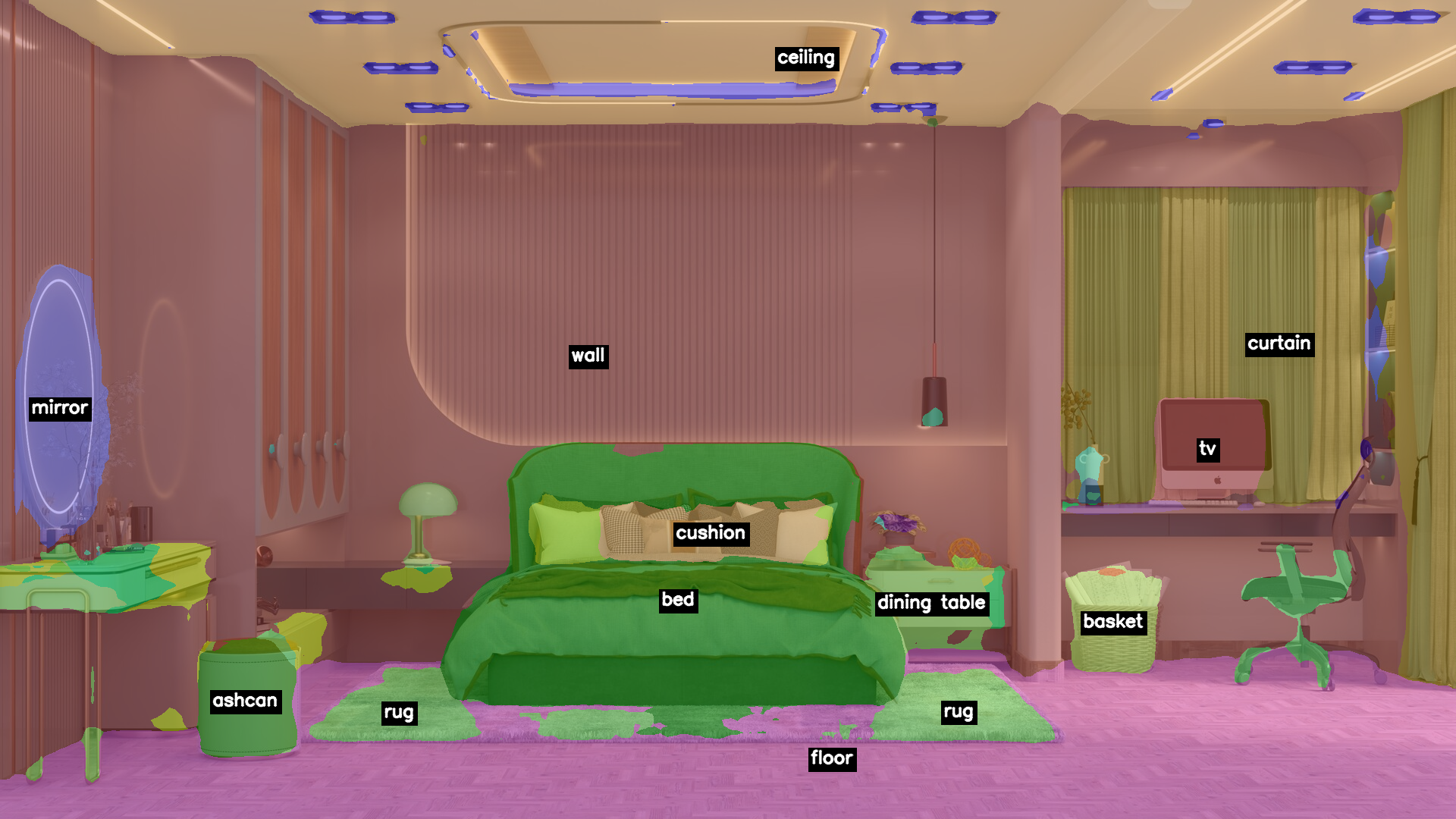
Top classes from the annotated scene above (descending pixel count):
wall          pixels=947236  points=947235
floor         pixels=274227  points=274227
ceiling       pixels=246675  points=246675
curtain       pixels=204965  points=204965
bed           pixels=150265  points=150265
mirror        pixels= 39858  points= 39858
Supported categories
The default checkpoint (segformer_b4_ade20k.bin) is trained on the ADE20K dataset and segments 150 scene classes. Each region is identified by its label (string) and class_id (0-based ADE20K index).
A handful of class names are aligned to their COCO synonym so masks flow directly into COCO-keyed pipelines such as Scale Observation size priors:
| ADE20K name | Used name (COCO) |
|---|---|
| sofa | couch |
| table | dining table |
| plant | potted plant |
| computer | laptop |
| television receiver | tv |
| minibike | motorcycle |
| glass | wine glass |
Ambiguous many-to-one cases keep the ADE20K name: animal (covers bird/cat/dog/…) and pot.
The full label set spans built-environment and "stuff" classes (wall, building, sky, floor, ceiling, road, sidewalk, grass, water, mountain), furniture (cabinet, chair, couch, bed, table, shelf, desk, wardrobe), and many fixtures and small objects. Classes the instance-based Object Mask Annotation 3D cannot label — walls, floor, sky, ceiling — are the core strength of this task.
Model backend
Default checkpoint download: segformer_b4_ade20k.bin
curl -L \
  https://github.com/OlafenwaMoses/vizion3D/releases/download/essentials-v1/segformer_b4_ade20k.bin \
  -o segformer_b4_ade20k.bin
| Value | What happens |
|---|---|
| (default) | Downloads segformer_b4_ade20k.bin to ~/.cache/vizion3d/models/ on first use, then loads it from cache |
A local .bin file path |
Loaded directly — never downloaded |
The SegFormer architecture is vendored in vizion3d.annotation.segformer, so no transformers dependency is needed at runtime — the raw checkpoint loads directly. Models are kept in memory after the first inference in the current process. Set VIZION3D_MODEL_CACHE to change the cache directory.
Command parameters
SceneMaskAnnotation3DCommand is the input contract for this task.
| Parameter | Type | Required | Default | Description |
|---|---|---|---|---|
point_cloud |
open3d.geometry.PointCloud |
Yes | — | Input point cloud in OpenGL/viewer camera space (X right, Y up, Z negative forward), coordinates in metres. |
image_input |
str \| bytes \| None |
No | None |
RGB image to segment. Pass a file path string or raw image bytes. When None, a front-view image is synthesised from the point cloud automatically. |
model_backend |
str |
No | vizion3D release checkpoint URL | SegFormer-B4 checkpoint URL or local path. |
return_region_clouds |
bool |
No | False |
When True, each SemanticMaskAnnotation3D includes a region_cloud — an extracted point cloud for that class with original colours preserved. |
return_annotated_cloud |
bool |
No | False |
When True, the result includes a copy of the full point cloud with every point recoloured by its class palette colour. |
advanced_config |
SceneMaskAnnotation3DConfig |
No | auto-derived from image/cloud | Camera intrinsics and inference size. |
SceneMaskAnnotation3DConfig fields: fx, fy, cx, cy (camera intrinsics, auto-derived when None) and inference_size (shorter image edge fed to the network, default 512; set 0 for native resolution — outputs are always at the original image resolution).
When image_input is omitted, the task renders a synthetic RGB front view from the point cloud before segmentation. Each point's XYZ position is projected into image pixels using fx, fy, cx, and cy, then its stored RGB colour is painted into the canvas. Pass explicit intrinsics for stereo clouds or calibrated scans; the fallback cloud-derived heuristic is useful for quick point-cloud-only runs, but it cannot recover a stereo rig's true focal length from geometry alone.
Result fields
SceneMaskAnnotation3DResult is the output contract for this task.
| Field | Type | Always present | Description |
|---|---|---|---|
annotations |
list[SemanticMaskAnnotation3D] |
Yes | Per-class annotations, sorted by descending pixel count. |
annotated_cloud |
open3d.geometry.PointCloud \| None |
When return_annotated_cloud=True |
Full point cloud copy with each point recoloured by its class palette colour. Coordinates remain OpenGL/viewer camera space. |
backend_used |
str |
Yes | Resolved local file path of the SegFormer checkpoint used. |
Each SemanticMaskAnnotation3D item contains:
| Field | Type | Description |
|---|---|---|
label |
str |
ADE20K class name (COCO-aligned where a 1:1 synonym exists). |
class_id |
int |
ADE20K class index (0-based, 0..149). |
bbox_2d |
list[float] |
Axis-aligned bounding box of the class region: [x1, y1, x2, y2] (empty if the class has no pixels). |
mask_2d |
np.ndarray |
Boolean semantic mask for this class, shape (H, W). |
pixel_count |
int |
Number of pixels classified as this class. |
point_indices |
list[int] |
Indices into the original input point cloud for all matched 3D points. |
point_coords |
list[list[float]] |
[[x, y, z], ...] in metres for each matched point. |
region_cloud |
open3d.geometry.PointCloud \| None |
Extracted sub-cloud for this class with original colours. Present when return_region_clouds=True. |
1. Direct Python import
import open3d as o3d
from vizion3d.annotation import SceneMaskAnnotation3D, SceneMaskAnnotation3DCommand

pcd = o3d.io.read_point_cloud("scene.ply")

with open("scene.jpg", "rb") as f:
    img_bytes = f.read()

result = SceneMaskAnnotation3D().run(
    SceneMaskAnnotation3DCommand(
        point_cloud=pcd,
        image_input=img_bytes,
        return_annotated_cloud=True,
    )
)

for ann in result.annotations:
    print(f"{ann.label:16s} pixels={ann.pixel_count:8d} points={len(ann.point_indices)}")

o3d.io.write_point_cloud("scene_annotated.ply", result.annotated_cloud)
Point cloud only (no image) — a front view is synthesised automatically:
result = SceneMaskAnnotation3D().run(
    SceneMaskAnnotation3DCommand(point_cloud=pcd)
)
Point cloud only with calibrated intrinsics:
from vizion3d.annotation.models import SceneMaskAnnotation3DConfig

result = SceneMaskAnnotation3D().run(
    SceneMaskAnnotation3DCommand(
        point_cloud=pcd,
        advanced_config=SceneMaskAnnotation3DConfig(
            fx=1733.74,
            fy=1733.74,
            cx=792.27,
            cy=541.89,
        ),
    )
)
Per-class extracted clouds:
result = SceneMaskAnnotation3D().run(
    SceneMaskAnnotation3DCommand(
        point_cloud=pcd,
        image_input="scene.jpg",
        return_region_clouds=True,
    )
)
for ann in result.annotations:
    if ann.region_cloud is not None:
        o3d.io.write_point_cloud(f"region_{ann.class_id:03d}_{ann.label}.ply", ann.region_cloud)
2. REST API
POST /annotation/scene-mask-annotation-3d (multipart form).
curl -X POST http://localhost:8000/annotation/scene-mask-annotation-3d \
  -F "image=@scene.jpg" \
  -F "point_cloud_ply=@scene.ply" \
  -F "return_annotated_cloud=true"
Without an image (front-view synthesised from the cloud):
curl -X POST http://localhost:8000/annotation/scene-mask-annotation-3d \
  -F "point_cloud_ply=@scene.ply"
Form fields: model_backend, return_region_clouds, return_annotated_cloud, fx, fy, cx, cy, inference_size. The JSON response contains an annotations list (with base64-encoded PNG mask_image and optional base64 PLY region_cloud_ply), an optional base64 annotated_cloud_ply, and backend_used.
Start the server with the feature enabled and the model pre-loaded:
uv run vizion3d-serve-rest --scene_model /path/to/segformer_b4_ade20k.bin
3. gRPC
LiftingService.RunSceneMaskAnnotation3D(SceneMaskAnnotation3DRequest) → SceneMaskAnnotation3DResponse.
import grpc
from vizion3d.proto import lifting_pb2, lifting_pb2_grpc

channel = grpc.insecure_channel("localhost:50051")
stub = lifting_pb2_grpc.LiftingServiceStub(channel)

with open("scene.ply", "rb") as f:
    ply_bytes = f.read()
with open("scene.jpg", "rb") as f:
    img_bytes = f.read()

response = stub.RunSceneMaskAnnotation3D(
    lifting_pb2.SceneMaskAnnotation3DRequest(
        image_bytes=img_bytes,
        point_cloud_ply=ply_bytes,
        return_annotated_cloud=True,
    )
)

for item in response.annotations:
    print(item.label, item.class_id, item.pixel_count, len(item.point_indices))
Inference performance
Warm inference (mean of 5 runs after model load) on Apple Silicon (MPS). Warm time is end-to-end per call including back-projection and mask assembly, not just the network forward pass.
| Task | Device | Input | Cold load (ms) | Warm (ms) | FPS |
|---|---|---|---|---|---|
| Depth Estimation | MPS | 1000×750 | 6586 | 370 | 2.7 |
| Stereo Depth | MPS | 450×375 | 3897 | 993 | 1.0 |
| Object Mask Annotation 3D | MPS | 1000×750 | 2290 | 157 | 6.4 |
| Scene Mask Annotation 3D | MPS | 1000×750 | 1852 | 852 | 1.2 |
| Scale Observation | MPS | 1000×750 | 102 | 96 | 10.4 |
The SegFormer network forward pass alone is ~370 ms at inference_size=512; the remainder of the warm time is the per-class grouping and mask assembly over a ~2 M-point cloud. Lower inference_size or use a smaller dense cloud to speed this up.